Desktop DDR5 · 2-channel
Max memory128GB
Theoretical bandwidth96GB/s
Reference build price$6,172
View the DDR5 RAM price trend and latest pricing for desktop sticks and server RDIMMs. Tables update every 6 hours with median asking price per stick, price per GB, and 7-day and 30-day changes. Server platforms often pair DDR5 RDIMMs with many memory channels to run large MoE local LLMs on CPU and RAM.
Loading chart…
Loading chart…
As an eBay Partner, VRAMGlass may be compensated if you buy through the eBay links on this page. The price you pay stays the same.
As an eBay Partner, VRAMGlass may be compensated if you buy through the eBay links on this page. The price you pay stays the same.
| Spec | Price per stick | Price per GB | Bandwidth per stick | 7-day change | 30-day change | 30-day trend | Buy |
|---|---|---|---|---|---|---|---|
| 16 GB | $55023 listings | $34.4 | 38.4 GB/s | 0.0% | -7.7% | Buy | |
| 16 GB | $53726 listings | $33.6 | 44.8 GB/s | -2.0% | -11.2% | Buy | |
| 32 GB | $1,14939 listings | $35.9 | 38.4 GB/s | +4.5% | -10.7% | Buy | |
| 32 GB | $1,29534 listings | $40.5 | 44.8 GB/s | -0.4% | -6.7% | Buy | |
| 64 GB | $2,20025 listings | $34.4 | 38.4 GB/s | -3.3% | -11.1% | Buy | |
| 64 GB | $2,54530 listings | $39.8 | 44.8 GB/s | -1.9% | -3.0% | Buy |
Price per stick is the median of the latest round of eBay listings; kits are split into single sticks first. Speeds are backward compatible: if a motherboard only supports 4800, a 5600 stick still works and runs at 4800.
Powered by VRAMGlass real-time price tracking — handpicking the best-value hardware deals across the web
As an eBay Partner, VRAMGlass may be compensated if you buy through the eBay links on this page. The price you pay stays the same.
 Used1x16GB Juhor Pro DDR5-6000 Desktop RAM PC UDIMMTop Rated$210Buy on eBay
 Used1x16GB Oloy Blade DDR5-6000 RAM Desktop UDIMM (MD5U1660382BRKDA)$210Buy on eBay
 Used1x32GB G.Skillz Trident DDR5-6000 RAM UDIMM Desktop (F5-6000J3636F32GX2-TZ5NR)Top Rated$425Buy on eBay
 UsedG. SKILL Trident Z5 RGB 32GB 1x32GB DDR5 6000 PC5-48000 UDIMM Desktop MemoryTop Rated$429Buy on eBay
Powered by VRAMGlass real-time price tracking — handpicking the best-value hardware deals across the web
As an eBay Partner, VRAMGlass may be compensated if you buy through the eBay links on this page. The price you pay stays the same.
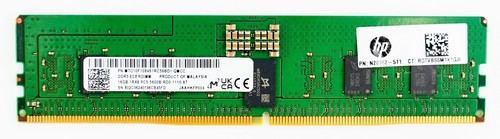 UsedMicron 16GB DDR5 5600MHz ECC EC8 REG RDIMM Server RAM 1Rx8 - MTC10F1084S1RC56BD1Top Rated$430Buy on eBay
 Used1x16GB Micron DDR5-5600 EC8 ECC RDIMM SERVER RAM Memory (MTC10F1084S1RC56BD1)Top Rated$475Buy on eBay
 UsedMicron MTC20C2085S1EC56BD1 32GB 5600B DDR5 ECC Server MemoryTop Rated$900Buy on eBay
 UsedSK HYNIX 32GB DDR5 5600 1RX4 ECC RDIMM MEMORY - HMCG84AGBRA186NTop Rated$1,290Buy on eBay
Offloading MoE expert weights to DDR5 RAM turns higher theoretical bandwidth into faster generation, while total capacity determines how large a model fits. A desktop PC, a single-socket server, and a dual-socket server, each with every DDR5 slot filled, are paired with one RTX 4090 that holds only the attention and shared weights.
DDR5 RAM includes on-die ECC inside every chip, and you do not need to buy ECC memory specifically to run local LLMs. On-die ECC only fixes internal chip errors, not data moving across the stick and motherboard to the CPU. Real ECC memory adds 8 or 4 check bits (EC8 or EC4) per 32-bit subchannel; all server RDIMMs have it, while desktops need both CPU and motherboard support.
DDR5 server RDIMMs and desktop UDIMMs carry onboard power management chips with different supply voltages, so they are not interchangeable. Server RDIMMs add a registering clock driver (RCD) chip to support more memory chips per channel, making 32GB and 64GB sticks with ECC common. The trade-off is lower speeds and looser timings, such as DDR5-4800 or 5600 on servers versus 6000 or 6400 on desktops.
The number before R is the rank count. A rank is a group of chips on the stick that are read and written together to make up 64 bits of data: 1R is single-rank, 2R is dual-rank. The number after x is the data width of each chip in bits. It takes 8 x8 chips or 16 x4 chips to make 64 bits, so x4 sticks can reach higher capacities, and most high-capacity server sticks are 2Rx4. The more ranks in a channel, the more likely the motherboard is to lower the memory speed when all slots are filled.
DDR5 RAM speed matters far more than CAS latency (CL) when running LLMs locally. CL measures the clock cycles before a read returns data, and real latency depends on speed too, putting common desktop DDR5-6000 CL30 at 10 ns and server DDR5-4800 CL40 at about 17 ns. Because each token moves several to tens of GB of weights, memory bandwidth dictates speed and timings barely matter.
You can mix DDR5 RAM of different brands, speeds, or sizes within the same stick type, though all modules run at the slowest speed and loosest timings and mismatched sizes reduce dual-channel bandwidth. Matching the model and batch is safest, and because 4 sticks force a big speed drop on most DDR5 desktops, use just 2 sticks if speed is the goal. Servers need identical sticks per channel for full bandwidth, while desktop and server sticks or DDR4 and DDR5 cannot be mixed.
On a dual-channel desktop, 4 sticks of DDR5 RAM are not faster than 2 sticks because extra sticks only add capacity, not bandwidth. Although each DDR5 stick splits into two 32-bit subchannels, it still transfers 8 bytes at a time, so per-stick bandwidth is speed times 8 (48 GB/s on DDR5-6000, or PC5-48000) and platform bandwidth multiplies by channels. That leaves a 2-channel desktop at 96 GB/s, while a 12-channel EPYC 9004 server filled with DDR5-4800 reaches 460.8 GB/s.
On a DDR5 RAM label, 4800B indicates the speed and JEDEC timing grade (CL40, while 5600B is CL46), PC5-38400 writes that same speed as bandwidth (4800 × 8 = 38400 MB/s), and EC8 means each subchannel carries 8 ECC check bits. Desktop sticks without EC8 only have chip-level on-die ECC. Elsewhere on the label, R marks a server RDIMM, U a desktop stick, and S a laptop stick.