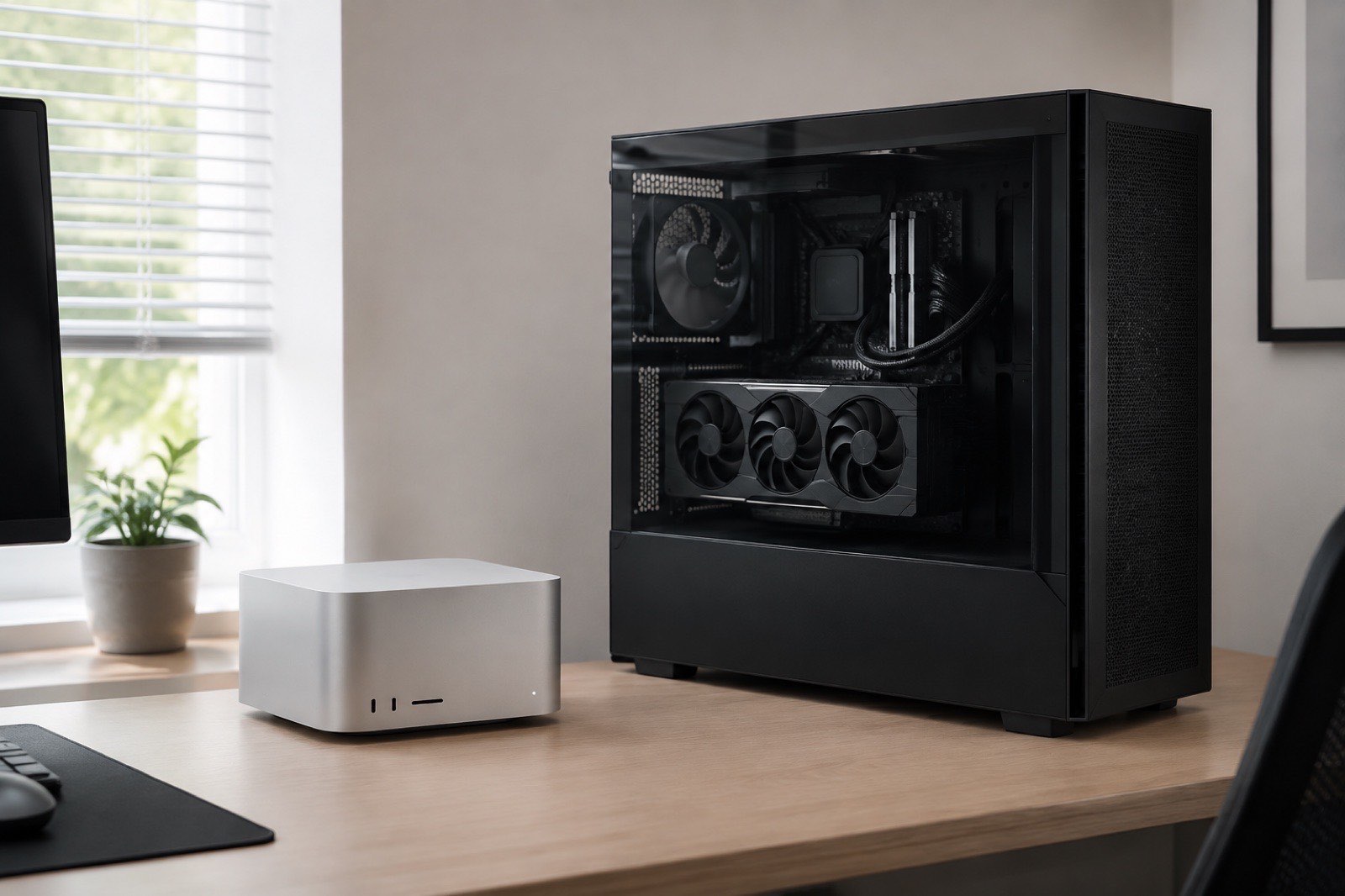
Apple's unified memory trades the "not enough VRAM" problem for a "not enough bandwidth" problem. A 128GB Mac Studio runs Llama 3.3 70B and gpt-oss 120B on one machine, which no consumer graphics card can do; but the same models on an RTX card that holds them run two to three times faster. As of September 5, 2026 our conclusion: choose a Mac for 100B-plus MoE models, silence and low power, or if you were buying a Mac anyway; choose RTX if your daily models are 8B to 32B dense and you care about response time and price per GB. Below, both sides go through the same formulas into the same tables.
How does unified memory differ from VRAM?
Unified memory is one pool of LPDDR5X shared by CPU and GPU, large and slow; VRAM is GDDR dedicated to the card, small and fast. The numbers:
| Machine | Memory / VRAM | Bandwidth | Type |
|---|---|---|---|
| Mac Studio M4 Max 128GB | 128 GB | 546 GB/s | LPDDR5X unified |
| Mac Studio M5 Max 128GB | 128 GB | 614 GB/s | LPDDR5X unified |
| Mac Studio M3 Ultra 512GB | 512 GB | 819 GB/s | LPDDR5X unified |
| RTX 3090 | 24 GB | 936 GB/s | GDDR6X |
| RTX 4090 | 24 GB | 1,008 GB/s | GDDR6X |
| RTX 5090 | 32 GB | 1,792 GB/s | GDDR7 |
| RTX PRO 6000 Blackwell | 96 GB | 1,792 GB/s | GDDR7 |
LLM decoding is bandwidth-bound: every generated token reads all active weights once, so speed ≈ bandwidth ÷ weight size. Capacity decides whether it runs, bandwidth decides how fast, and each side is short on exactly what the other has.
The largest model at the same price
Under $4,000, the largest model a Mac runs is 70B dense or 120B MoE, while RTX stops at 32B dense; only above $15,000 does the RTX PRO 6000 match the Mac's capacity. Current used prices and the largest dense tier at 4-bit / 8K:
| Spec | Mac Studio M4 Max 128GB |  GeForce RTX 4090 GeForce RTX 4090 | GeForce RTX 5090 | RTX PRO 6000 Blackwell |
|---|---|---|---|---|
| VRAM | 128 GB LPDDR5X | 24 GB GDDR6X | 32 GB GDDR7 | 96 GB GDDR7 ECC |
| Bandwidth | 546 GB/s | 1,008 GB/s | 1,792 GB/s | 1,792 GB/s |
| BF16 | — | 330.3 TFLOPS | 419 TFLOPS | 500 TFLOPS |
| INT8 | — | 661 TOPS | 838 TOPS | 1,000 TOPS |
| Power | 480 W | 450 W | 575 W | 600 W |
| Interface | — | PCIe 4.0 x16 | PCIe 5.0 x16 | PCIe 5.0 x16 |
| Launch date | Mar 12, 2025 | Oct 12, 2022 | Jan 30, 2025 | Mar 18, 2025 |
| MSRP | — | $1,599 | $1,999 | — |
| eBay (US used) | — | $3,200 | $6,492 | $16,985 |
| Price per GB | — | $133 | $203 | $177 |
| Largest dense model (4-bit, 8K) | 70B | 32B | 32B | 70B |
| Llama 3.3 70B speed | 7 t/s | Too big | Too big | 30 t/s |
An M4 Max 128GB costs about as much as one RTX 4090, and the 4090 cannot hold a 70B. The cheapest GPU path to 70B at 4-bit is two 3090s (48GB, about $3,400), see multi-GPU basics.
Speed: bandwidth decides everything
On models both hold, the RTX 4090 is more than twice as fast as an M4 Max; on the big models only the Mac holds, RTX with expert offload is slower than the Mac. Estimated decode speed (4-bit, 8K context):
| Model | Qwen3 8B | Qwen3.8 27B | Llama 3.3 70B | gpt-oss 120B |
|---|---|---|---|---|
| Mac Studio M4 Max 128GB | 55 | 18 | 7 | 68 |
| Mac Studio M5 Max 128GB | 61 | 20 | 8 | 74 |
| Mac Studio M3 Ultra 512GB | 81 | 26 | 11 | 90 |
| GeForce RTX 3090 | 114 | 38 | Too big | 21* |
| GeForce RTX 4090 | 122 | 41 | Too big | 21* |
| GeForce RTX 5090 | 201 | 70 | Too big | 21* |
| DGX Spark 128GB | 36 | 11 | 5 | 48 |
 Ryzen AI Max+ 395 128GB Ryzen AI Max+ 395 128GB | 24 | 8 | 3 | 35 |
Estimated decode speed at 4-bit with an 8K context, single stream. Values marked * are MoE models running with expert weights in system RAM (70 GB/s assumed).
Three takeaways:
- On 8B to 27B dense models the Mac feels slow: Qwen3.8 27B runs near 18 tokens/s on an M4 Max and 41 on a 4090.
- Big MoE models like gpt-oss 120B are the Mac's home turf: about 68 tokens/s fully in memory, while the 4090 must park the experts in system RAM at about 21.
- The DGX Spark and Ryzen AI Max+ 395 are low-bandwidth 128GB machines: the same 70B runs at 3 to 5 tokens/s, fine for batch jobs and development, not for chat.
Is a Mac the only single machine for 70B and up?
No, but it is the least hassle: the GPU routes are two 24GB cards or one 96GB RTX PRO 6000, one a case-and-PSU project and the other over $15,000. The paths to 70B at 4-bit:
- Two RTX 3090s: 48GB for about $3,400, an estimated 16 tokens/s, twice the Mac, but a 1000W PSU, a big case, noise and heat.
- RTX 4090 48GB modded card: 48GB on one card, about $3,800 used, 17 tokens/s, no warranty.
- RTX PRO 6000 Blackwell 96GB: about 30 tokens/s with room for a 128K context, around $17,000.
- Mac Studio M4 Max / M5 Max 128GB: 7 to 8 tokens/s, silent, under 150W, and it is also your computer.
- Mac Studio M3 Ultra 512GB: the only home machine that holds DeepSeek V4 Flash (155 GB) and Qwen3.8 Flash Next whole; V4 Flash runs near 47 tokens/s.
For MoE models above 200B, the 512GB Mac is the only home answer. For 70B dense, two 3090s are faster and cheaper.
Software: MLX, llama.cpp and Ollama on a Mac
llama.cpp and Ollama work out of the box on a Mac, MLX is 10% to 20% faster than llama.cpp on Apple Silicon, and vLLM and fine-tuning remain CUDA territory.
- llama.cpp / Ollama: the Metal backend is mature, GGUF files just work,
ollama runis one command. This is the basis of the speed estimates above. - MLX: Apple's own framework with its own weight format (the mlx-community organization on Hugging Face covers the popular models); decode is typically 10% to 20% faster than llama.cpp, and LM Studio ships it built in.
- vLLM / SGLang: no Metal backend, so batch serving and high concurrency are not a Mac job.
- Fine-tuning: MLX does LoRA, several times slower than an RTX card at the same price; serious fine-tuning still means CUDA.
- Memory cap: macOS lets the GPU use about 75% of unified memory by default;
sudo sysctl iogpu.wired_limit_mb=110000opens a 128GB machine up to 110GB.
Verdict by need
70B and up at under 10 tokens/s: Mac. Daily 32B and below, fast and cheap: RTX. Both: two 3090s plus an ordinary Mac.
- Choose a Mac for big MoE models like gpt-oss 120B, GLM 4.5 Air or DeepSeek V4 Flash; for an office or bedroom that must stay quiet; or if you were replacing a Mac anyway.
- Choose RTX for daily 8B to 32B models where response time comes first; for fine-tuning and vLLM serving; or when the budget is judged by price per GB, see best budget GPU.
- Skip the DGX Spark and Ryzen AI Max+ 395 unless you need a CUDA development box (Spark) or x86 Linux (Strix Halo); for the same money an M4 Max is twice as fast.
- AMD cards have a lower price per GB but ecosystem traps, see the state of AMD GPUs for local LLMs.