Tesla V100 32GB + Dual Xeon E5 DDR4
BudgetGeneration speed7.1t/s
Memory bandwidth137GB/s
Reference build price$4,113
 Run Hy4 Locally: VRAM & GPU Requirements
Hy4 is Tencent Hunyuan's flagship multimodal MoE from November 2026, with a 770B language backbone using 49B per token and about 470 GB at 4-bit. Its backbone is identical in size to August's Hy4 preview, adding a vision encoder for images and video. Among single machines, only a 512GB Mac Studio M3 Ultra can hold it; a single discrete GPU or a 128GB system cannot run it. Support in llama.cpp is not merged into mainline yet, so you have to compile the branch yourself, and Ollama's official library does not have it.
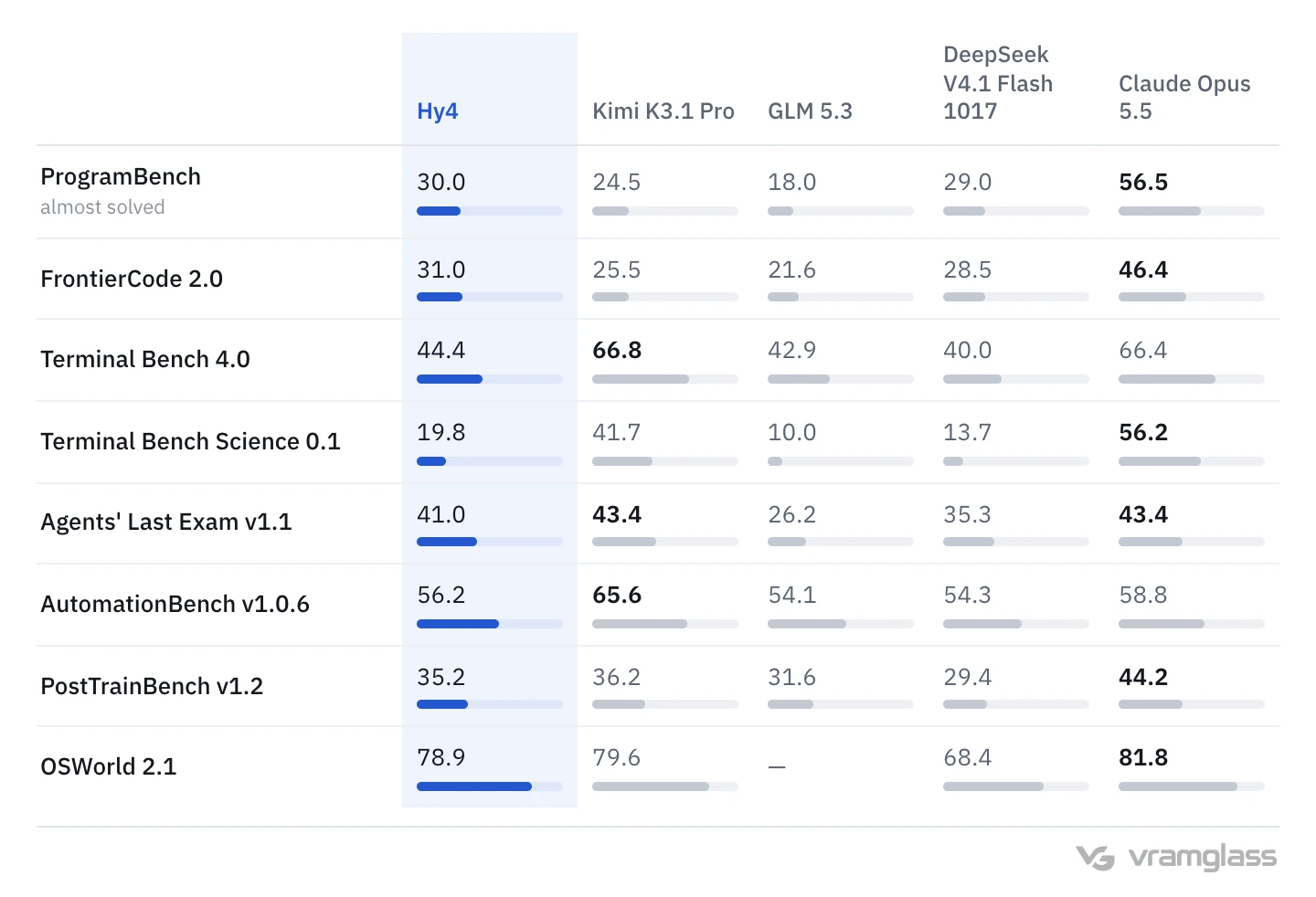
The hardware requirements are nearly unchanged: both share a 770B language backbone with 49B active parameters and 78 layers, so any hardware that fits Hy4 preview will fit Hy4 (the 4-bit file is only about 3 GB larger). The biggest functional change is a new 1.23B vision encoder that takes it from text-only to understanding images and video, alongside switching the draft model to DFly2, which uses no extra VRAM. On benchmarks, it improves by 19.1% over Hy4 preview on the GameDev evaluation, lowers its self-tested hallucination rate with search optimization from 15.76% to 5.45%, and scores 3.04 out of 4 on 579 real-world financial tasks graded by 213 finance experts (ahead of DeepSeek V4.1 Flash 1017 at 2.97). On the Terminal-Bench 4.0 coding benchmark, however, it scores 44.4 compared to 66.4 for Claude Opus 5.5, and Tencent itself acknowledges a noticeable gap behind leading closed-source models. All of the benchmark scores and comparisons above were published by Tencent.
Running the officially recommended 4-bit quantization (Hy4-Q4_K_M.gguf) with 32K context takes about 474 GB of VRAM, only about 3 GB more than the same quantization of Hy4 preview. Its attention architecture keeps the context cache very small, so even maxing out the context to 1M tokens brings total VRAM to only about 566 GB. If VRAM is tight, the 2-bit build (Hy4-IQ2.gguf) drops that to about 336 GB at 32K, while the smallest 1-bit build (Hy4-STQ1_0.gguf) still takes about 235 GB. For image or video input, set aside another 2.7 GB or so to load the vision encoder file mmproj-HY4-VL-BF16.gguf.
| Quantization | WeightsGB | 32K contextGB | 128K contextGB | 256K contextGB | 1M context (max)GB |
|---|---|---|---|---|---|
| 1-bit | 230.5GGUF | 234.5 | 243.4 | 255.1 | 325.8 |
| 2-bit | 332.4GGUF | 336.4 | 345.3 | 357 | 427.7 |
| 3-bit | 396.2est. | 400.2 | 409 | 420.8 | 491.5 |
| 4-bit | 470.2GGUF | 474.2 | 483.1 | 494.8 | 565.5 |
| 5-bit | 557.9est. | 561.9 | 570.7 | 582.5 | 653.2 |
| 8-bit | 786.3official | 790.3 | 799.2 | 810.9 | 881.6 |
| BF16/FP16 | 1,548.9official | 1,552.9 | 1,561.8 | 1,573.5 | 1,644.2 |
Full calculation rules are on the Methodology page.
No. The largest discrete GPU currently available has only 96GB of VRAM, which cannot hold even half of the smallest 1-bit quantization (about 235 GB). A 128GB DGX Spark or a 128GB Mac cannot run it either; among single machines, only the 512GB Mac Studio M3 Ultra fits it. On that Mac, 4-bit runs at about 19 tokens/s (with context up to about 850K tokens) and 2-bit runs at about 26 tokens/s, as activating 49B parameters on every token is bottlenecked by single-machine memory bandwidth. Running 4-bit uses about 472 GB of memory, which exceeds the default GPU allocation limit in macOS, so you have to raise that limit manually before launching.
| Device | Price | Speed t/s | Max context |
|---|---|---|---|
| Mac Studio M3 Ultra 512GBWhole system · 512 GB | $23,00011 listings | 25.7 | 1M |
| Device | Price | Speed t/s | Max context |
|---|---|---|---|
| Mac Studio M3 Ultra 512GBWhole system · 512 GB | $23,00011 listings | 18.9 | 852K |
Only common GPUs and systems are listed, from cheapest to most expensive.
Running 4-bit takes at least eight GPUs with 64GB or more each, such as eight 96GB RTX PRO 6000 cards at about 36 tokens/s, or eight 80GB A100 cards at about 39 tokens/s. Dropping to the 2-bit build (Hy4-IQ2.gguf) lowers the requirement to four RTX PRO 6000 cards (about 47 tokens/s), or eight 48GB RTX A6000 or 48GB modded RTX 4090 cards (about 23 to 30 tokens/s). Running the official FP8 weights in vLLM with 8-GPU tensor parallelism requires about 944 GB of total VRAM, and the official recipe is written for eight B300 GPUs by default. The AMD Instinct series is not supported yet because the AMD build of vLLM does not have its vision encoder or the DFly2 draft model.
| Device | Cards | Total price | Total VRAM | Speed t/s | Total power |
|---|---|---|---|---|---|
 DGX Spark 128GB128 GB per unit | 4 units | $31,996 | 512 GB | 8.9 | 960 W |
| RTX A600048 GB per card | 8 cards | $39,760 | 384 GB | 23.2 | 2,400 W |
| Instinct MI21064 GB per card | 8 cards | $40,344 | 512 GB | 44.1 | 2,400 W |
| RTX PRO 600096 GB per card | 4 cards | $76,000 | 384 GB | 47.3 | 2,400 W |
| RTX PRO 5000 72GB72 GB per card | 8 cards | $76,000 | 576 GB | 37.6 | 2,400 W |
| A100 80GB PCIe80 GB per card | 8 cards | $135,992 | 640 GB | 50.2 | 2,400 W |
| GeForce RTX 4090 48GB48 GB per card | 8 cards | No price | 384 GB | 29.5 | 3,600 W |
| Device | Cards | Total price | Total VRAM | Speed t/s | Total power |
|---|---|---|---|---|---|
| DGX Spark 128GB128 GB per unit | 4 units | $31,996 | 512 GB | 6.5 | 960 W |
| Instinct MI21064 GB per card | 8 cards | $40,344 | 512 GB | 33.7 | 2,400 W |
| RTX PRO 5000 72GB72 GB per card | 8 cards | $76,000 | 576 GB | 28.5 | 2,400 W |
| A100 80GB PCIe80 GB per card | 8 cards | $135,992 | 640 GB | 38.7 | 2,400 W |
| RTX PRO 600096 GB per card | 8 cards | $152,000 | 768 GB | 36.3 | 4,800 W |
| Device | Cards | Total price | Total VRAM | Speed t/s | Total power |
|---|---|---|---|---|---|
| Mac Studio M3 Ultra 512GB512 GB per unit | 2 units | $46,000 | 1,024 GB | 11.5 | 960 W |
Mac Studios link up over Thunderbolt 5 and run with MLX or exo; vLLM doesn't support them. Full calculation rules are on the Methodology page.
With MoE offloading that puts the routed experts in system RAM and keeps only the shared weights used on every token (about 19 GB) on the GPU, running 4-bit requires a dual-socket server, as a dual-channel consumer desktop maxed out on RAM cannot hold about 455 GB of experts. A single RTX 3090 in a dual-socket EPYC 16-channel DDR4 server (512GB of system RAM) is enough to start it, reaching an estimated 10 tokens/s based on memory bandwidth. Moving to a 24-channel DDR5 dual-socket EPYC server with four RTX 5090 cards and 384GB of system RAM raises speed to about 26 tokens/s. If you switch to 2-bit (about 322 GB of experts), an older dual-socket E5 server with eight V100 32GB cards needs only 128GB of system RAM to fit it, at an estimated 18 tokens/s (all speeds above are estimated from memory bandwidth, as there are no public benchmarks yet).
Detailed calculation rules are on the Methodology page.
As an eBay Partner, VRAMGlass may be compensated if you buy through the eBay links on this page. The price you pay stays the same.
As of November 20, support for Hy4 in llama.cpp is still in PR #32517 and has not been merged into mainline, so you have to pull and compile that branch yourself. You must pass --jinja when chatting because its chat template differs from all of llama.cpp's built-in templates. Running FP8 in vLLM or SGLang also requires the dedicated vllm/vllm-openai:hy4 or lmsysorg/sglang:hy4 container images; native support in vLLM will land in the official 0.35.0 release.
Tencent's AngelSlim team released three builds. If you have enough VRAM or system RAM, pick the standard 4-bit Hy4-Q4_K_M.gguf (about 470 GB), ideally stored on a local drive to avoid slow loading. To use fewer GPUs, pick Hy4-IQ2.gguf at about 332 GB, which drops only the gate and up weights inside the routed experts to about 2.3 bits while keeping everything else the same as 4-bit. The smallest build, Hy4-STQ1_0.gguf (about 230 GB), compresses those two weight types down to about 1.3 bits, and running it requires applying the extra STQ1_0 patch included in the repository when compiling.
All three text GGUFs share the same vision encoder file, mmproj-HY4-VL-BF16.gguf (about 2.7 GB). Load it alongside the model with --mmproj when working with images or video, or skip it for text-only chat. Its speculative decoding draft model has also been replaced with the 5-layer DFly2 (where a small 3.3B model guesses several tokens ahead and the main model verifies them in one pass to speed up generation), which reuses the main model's context cache directly and takes no extra VRAM.
reasoning_effort can be set to high or no_think, and defaults to high (deep thinking enabled), where the model outputs its reasoning process before the final answer, so make sure to leave a generous max output length. Pass no_think for direct answers in everyday chat. The officially recommended sampling parameters are the same as for Hy4 preview: temperature 0.9 and top_p 1.0.
Hy4 does not keep the Apache 2.0 license from Hy4 preview, switching instead to the Tencent Hy License just like Hy4 Flash. Internal company use and building the model into fixed-function end products (without exposing a general-purpose model API) are unrestricted. You only need prior written authorization from Tencent if you offer an external model API (MaaS) and have over 50 million US dollars in annual global revenue, or use the model in a product with over 100 million monthly active users.
Follow the deployment guide to prepare the required runtime and hardware.
./build/bin/llama-server -m Hy4-Q4_K_M.gguf \
  --mmproj mmproj-HY4-VL-BF16.gguf -c 8192 -ngl 99 --jinja --port 8080
 vLLM
Follow the deployment guide to prepare the required runtime and hardware.
docker run --gpus all \
  -p 8000:8000 \
  --ipc=host \
  -e VLLM_USE_RUST_FRONTEND=1 \
  -v ~/.cache/huggingface:/root/.cache/huggingface \
  vllm/vllm-openai:hy4 tencent/Hy4-FP8 \
    --dtype bfloat16 \
    --limit-mm-per-prompt '{"image":1,"video":0}' \
    --tensor-parallel-size 8 \
    --speculative-config '{"num_speculative_tokens":5,"method":"dfly"}' \
    --attention-backend FLASHMLA_SPARSE \
    --tool-call-parser hy_v4 \
    --reasoning-parser hy_v4 \
    --enable-auto-tool-choice \
    --port 8000 \
    --served-model-name hy4
The Ollama library has no official tag for it yet.
File names follow that week's model-library snapshot; the definitions are in the methodology. Methodology
| Model | Total params | Active params | 4-bit size |
|---|---|---|---|
| Hy4 FlashMoE | 220B | 12B | 168.3 GB |
| Hy3MoE | 295B | 21B | 182.2 GB |
| Hy4 previewMoE | 770B | 49B | 467.3 GB |