4 × Tesla V100 32GB + Dual Xeon E5 8-GPU server
BudgetGeneration speed5.1t/s
Memory bandwidth137GB/s
- PSU
- Built-in 4 × 1,600 W
- Included
Reference build price$8,750
 How to Deploy Kimi K3.1 Pro Locally
Kimi K3.1 Pro is Moonshot AI's new flagship, announced on October 24, 2026: Kimi K3 with more post-training and the same architecture. It's a 2.8T-parameter MoE with image understanding and 1M of context. Moonshot AI has promised to open-source the full weights by November 4; until then, you can only use it through the Kimi apps and the API. It's as large as K3, about 861 GB at 2-bit and about 1,509 GB at 4-bit, so it won't fit on any single GPU or single workstation. The VRAM figures on this page are estimated from K3's files, which share the same architecture, and will be checked against the actual files once the weights are out.
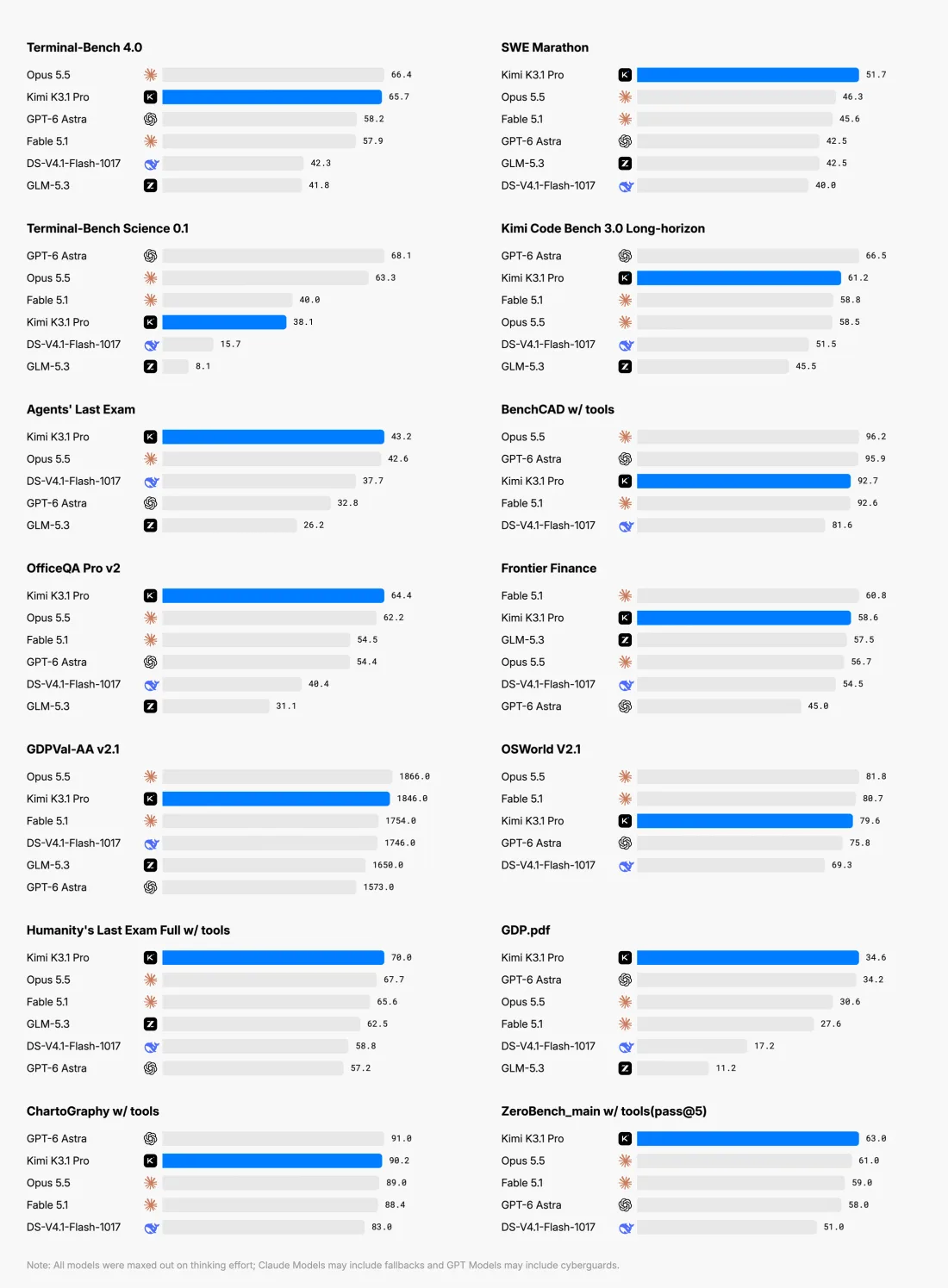
It's better at coding, 3D work and financial analysis, and the hardware bar hasn't moved: the architecture matches K3, so hardware that runs K3 runs it too. In Moonshot AI's own benchmarks, it scores 65.7 on Terminal-Bench 4.0, which tests completing coding tasks in a terminal, less than 1 point behind Claude Opus 5.5's 66.4. On an internal long-horizon coding test, it rises from K3's 56.0 to 61.2. It also hallucinates much less: on Moonshot AI's deliberately hard fact-checking test, the share of individual claims that are wrong drops from K3's 23.4% to 8.3%. All of these scores were published by Moonshot AI itself; for how they were tested, see the original post linked under the image.
Like K3, it needs several hundred GB at minimum: about 649 GB at 1-bit, about 861 GB at 2-bit and about 1,509 GB at 4-bit. At 8-bit it's about 1,561 GB, only slightly larger than 4-bit, because K3's experts were already 4-bit in training, so 8-bit simply keeps them as they are. Context is light on VRAM: only 24 of the 93 layers have a cache that grows with context, so at 4-bit, going from 32K to 1M adds only about 28 GB. These figures are estimated from the sizes of K3's GGUF files and will be replaced with measured sizes once K3.1 Pro's files are out.
| Quantization | WeightsGB | 32K contextGB | 128K contextGB | 256K contextGB | 1M context (max)GB |
|---|---|---|---|---|---|
| 1-bit | 648.9est. | 650.9 | 653.6 | 657.2 | 679 |
| 2-bit | 861.3est. | 863.3 | 866 | 869.6 | 891.4 |
| 3-bit | 1,440.6est. | 1,442.6 | 1,445.3 | 1,448.9 | 1,470.7 |
| 4-bit | 1,508.7est. | 1,510.7 | 1,513.4 | 1,517 | 1,538.8 |
| 5-bit | — | — | — | — | — |
| 8-bit | 1,561.2est. | 1,563.2 | 1,565.9 | 1,569.5 | 1,591.3 |
| BF16/FP16 | 5,880est. | 5,882 | 5,884.7 | 5,888.3 | 5,910.1 |
Full calculation rules are on the Methodology page.
No. Like K3, it won't fit on any single GPU or single workstation. The smallest build, 1-bit, is about 649 GB, already more than the 512GB Mac Studio M3 Ultra. 2-bit, at about 861 GB, won't fit even on eight 96GB cards combined. What can hold it is several linked 512GB Mac Studios: two for 2-bit and four for 4-bit.
| Device | Cards | Total price | Total VRAM | Speed t/s | Total power |
|---|---|---|---|---|---|
| Mac Studio M3 Ultra 512GB512 GB per unit | 2 units | $43,340 | 1,024 GB | 17.7 | 960 W |
| Device | Cards | Total price | Total VRAM | Speed t/s | Total power |
|---|---|---|---|---|---|
| Mac Studio M3 Ultra 512GB512 GB per unit | 4 units | $86,680 | 2,048 GB | 10.6 | 1,920 W |
| Device | Cards | Total price | Total VRAM | Speed t/s | Total power |
|---|---|---|---|---|---|
| Mac Studio M3 Ultra 512GB512 GB per unit | 4 units | $86,680 | 2,048 GB | 10.2 | 1,920 W |
Mac Studios link up over Thunderbolt 5 and run with MLX or exo; vLLM doesn't support them. Full calculation rules are on the Methodology page.
You need a server-class machine. A dual-socket EPYC server (24 channels of DDR5) with every slot filled for 1.5TB of RAM, plus four RTX 5090 cards holding some of the experts, runs 4-bit at about 14 tokens/s. Drop to 2-bit and the RAM halves to 768GB, while the speed actually rises to about 23 tokens/s. Older hardware can do it too: at 2-bit, an old server with four V100 32GB cards and 768GB of DDR4 also runs it, but only at about 6 tokens/s. These setups can run Kimi K3 today; once the K3.1 Pro weights are out, just swap in the new files.
Detailed calculation rules are on the Methodology page.
As an eBay Partner, VRAMGlass may be compensated if you buy through the eBay links on this page. The price you pay stays the same.
Moonshot AI says the full weights will be out by November 4. Until then, you can use it on the Kimi website and app and in Kimi Code, or call the API with the model name kimi-k3.1-pro. There's also kimi-k3.1-pro-highspeed, which Moonshot AI says is 2 to 3 times faster. So far it's only mentioned for the API, with no word on whether its weights will be released separately.
As with K3, thinking is always on; you can only choose low, high or max with reasoning_effort, and the default is max. The API fixes temperature at 1.0 and top_p at 0.95, so you don't need to pass them. In multi-turn conversations and tool calls, send back the whole response unchanged.
If the architecture is unchanged, existing K3 support should work as-is: mainline llama.cpp merged the text part of K3 in August (PR #26185), and vLLM has a dedicated kimi-k3 image. Whether it actually loads without changes can only be tested once the weights are out. This page will add launch commands after the GGUFs and the vLLM recipe come out and have been checked.
K3 uses its own Kimi K3 License: “model as a service” businesses with revenue above a threshold must sign a separate agreement with Moonshot AI before commercial use. Moonshot AI won't announce K3.1 Pro's license until it releases the weights, so if you plan commercial use, don't assume K3's terms apply yet.
| Model | Total params | Active params | 4-bit size |
|---|---|---|---|
| Kimi Linear 48B A3BMoE | 49.1B | 3B | 30.1 GB |
| Kimi K2MoE | 1,000B | 32B | 621.3 GB |
| Kimi K2.5MoE | 1,000B | 32B | 621.2 GB |
| Kimi K2.6MoE | 1,000B | 32B | 583.7 GB |
| Kimi K2.7 CodeMoE | 1,000B | 32B | 583.7 GB |
| Kimi K3MoE | 2,800B | 104B | 1,508.7 GB |